MockCC37 Sigmoid volvulus
-
Stem : 85-year-old lady living in care home. She uses a wheelchair and has long-standing constipation. She presented in the A&E with abdominal pain, constipation, marked abdominal distention, vomiting and dehydration
Labs: Na 120, ABG: PH 7.5, PCO₂ 4.2.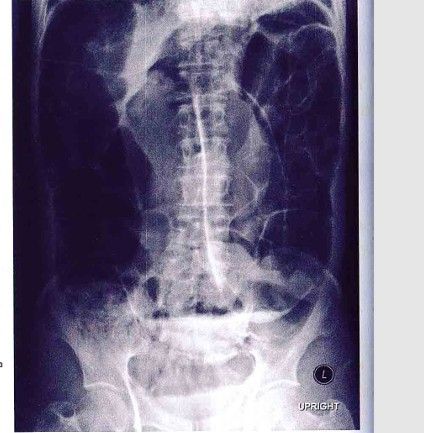
What are the possible causes of this clinical picture?
Given the age of the patient, past medical history and long history of constipation, as well as AXR showing coffee-bean shape so I should suspect sigmoid volvulus.
What is your interpretation of this ABG?
Metabolic alkalosis
Explain the biochemical abnormalities, why alkalosis?
Loss of H⁺ in the vomitus.
Increase bicarbonate uptake in renal tubules in response to loss of chloride in order to maintain electrochemical neutrality.
Retention of bicarbonate-rich pancreatic juice due to loss of acid load in the duodenum.Why hyponatremia?
Kidneys excrete more NaHCO₃ to reduce blood alkalinity.
Na loss in vomitus also.Why hypochloraemia?
Due to loss of chloride (HCL) in the vomitus.
Why hypokalaemia?
Due to increased aldosterone in response to hypovolemia which will absorb Na and water in exchange of K in the kidney.
Loss of K⁺ in vomitus.Why raised Bicarbonate?
Due to increased bicarbonate uptake in renal tubules in response to loss of chloride in order to maintain electrochemical neutrality.
Why aciduria?
Loss of H⁺ in urine in exchange of Na⁺
Is NaHCO₃ excreted as a whole ion?
Yes
How would manage this patient?
I would manage the patient according to CCriSP protocol (ABC)
Keep NBM, NG tube
Catheter and fluid balance chart
IV access
Start IV fluid (normal saline + kcl)
Monitor vital signs (pulse, BP, UOP and capillary refill time and mental state)
Early detorsion with rigid sigmoidoscopy +/- insertion of flatus tube (rectal tube)
I will first try rigid sigmoidoscopy, if fails then I will do flexible sigmoidoscopy
Followed by elective surgery to correct underlying causeWhat are the symptoms and signs of sigmoid volvulus?
Constipation
Abdominal distension
Abdominal pain
Late vomiting (Feculent vomiting)
Signs of dehydration (tachycardia, hypotension, oliguria)
Distended tender abdomenWhat are its complications?
Bowel ischemia and gangrene
Perforation
Peritonitis and sepsisWho are you going involve in the care of this lady?
Colorectal Surgeon
Anaesthetist
ITU
CardiologistDefine volvulus?
A volvulus is a twisting or axial rotation of a portion of bowel around its mesentery, can lead to obstruction of the lumen and vascular occlusion.
The rotation causes obstruction of the lumens (>180° torsion) and if tight enough also causes vascular occlusion in the mesentery (>360° torsion)Risk factors of volvulus
Increasing age
Male gender
Chronic constipation or laxative use
Previous abdominal operations
Neuropsychiatric disorders
Nursing home residentWhat are the different surgical options for treating a patient with sigmoid volvulus?
Hartmann’s procedure with end colostomy or Mikulicz procedure.
Laparotomy with manual detorsion and assess for viability. If viable do sigmoidopexy to the lateral wall of abdomen or pelvis. -
What are the clinical manifestations of hyponatremia?
Arrhythmia and cardiac arrest
Confusion
Agitation
Fits
Reduced GCSWhat are the causes of hyponatremia?
According to serum osmolarity, hyponatremia can be divided into: Isotonic, Hypotonic, Hypertonic
Hypotonic hyponatremia can be divided according to volume status:
Hypovolemic hyponatremia e.g. diarrhoea, vomiting and diuretics
Euvolemic hyponatremia e.g. SIADH, hypothyroidism
Hypervolemic hyponatremia e.g. heart failure
Pseudohyponatremia: Multiple myeloma
Hello! It looks like you're interested in this conversation, but you don't have an account yet.
Getting fed up of having to scroll through the same posts each visit? When you register for an account, you'll always come back to exactly where you were before, and choose to be notified of new replies (either via email, or push notification). You'll also be able to save bookmarks and upvote posts to show your appreciation to other community members.
With your input, this post could be even better 💗
Register Login