Senior Engineers Are the Next DRAM Shortage
-
ETA: summary…
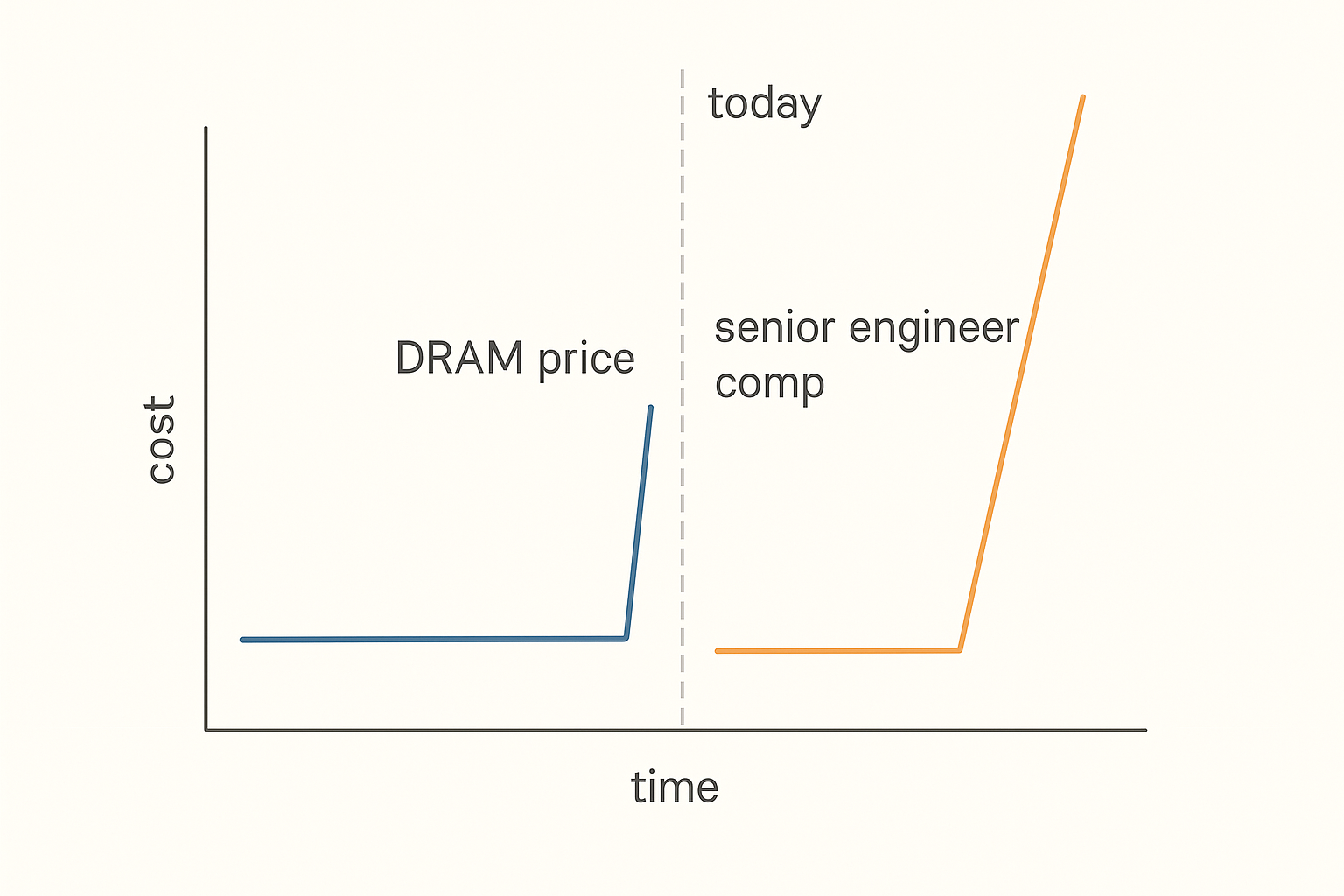
Author describes how agentic coding tools have disincentivized the developer training and mentorship pipeline that the software industry has implicitly relied on to produce seasoned developers, predicting that once the shortage is fully realized it could take years to reverse.
The solution proposed is for managers and senior developers to get ahead of this shortage by foregoing the immediate yet shortlived productivity maximization offered by the agent-multiplied-senior structure in favor of longterm sustainability by deliberately facilitating experience fan-out to juniors.
The methodology proposed is based on a successful nuclear engineering apprenticeship program carried out on active service naval submarines.
Senior Engineers Are the Next DRAM Shortage
There’s a shortage coming that nobody’s put on a slide yet: senior engineers. Every company on earth is about to want one who can drive a fleet of agents with judgment — and almost nobody …
Greg Herlein (blog.herlein.com)
-
ETA: summary…
Author describes how agentic coding tools have disincentivized the developer training and mentorship pipeline that the software industry has implicitly relied on to produce seasoned developers, predicting that once the shortage is fully realized it could take years to reverse.
The solution proposed is for managers and senior developers to get ahead of this shortage by foregoing the immediate yet shortlived productivity maximization offered by the agent-multiplied-senior structure in favor of longterm sustainability by deliberately facilitating experience fan-out to juniors.
The methodology proposed is based on a successful nuclear engineering apprenticeship program carried out on active service naval submarines.
Senior Engineers Are the Next DRAM Shortage
There’s a shortage coming that nobody’s put on a slide yet: senior engineers. Every company on earth is about to want one who can drive a fleet of agents with judgment — and almost nobody …
Greg Herlein (blog.herlein.com)
Articles about this looming problem aren’t new, but this one stood out to me for the author’s diligence in
- projecting the scope of the problem at scale convincingly without resorting to hyperbole,
- demonstrating the problem-solution framing engineering leads will inevitably need in order to convince clients and stakeholders (i.e., via market anticipation/contingencies/scalability rather than true yet unpersuasive appeals to the common good), and
- actually proposing a grounded methodology, with concrete reporting and workflow examples, toward rebuilding and maintaining the endangered training and mentorship pipelines in the context of agentic development instead of just pressing a hardliner easybutton before acknowledging its impossibility and declaring the illness terminal.
I’m particularly interested to hear critique of the author’s apprenticeship model, where it might fail, how it might be improved, etc.
-
Articles about this looming problem aren’t new, but this one stood out to me for the author’s diligence in
- projecting the scope of the problem at scale convincingly without resorting to hyperbole,
- demonstrating the problem-solution framing engineering leads will inevitably need in order to convince clients and stakeholders (i.e., via market anticipation/contingencies/scalability rather than true yet unpersuasive appeals to the common good), and
- actually proposing a grounded methodology, with concrete reporting and workflow examples, toward rebuilding and maintaining the endangered training and mentorship pipelines in the context of agentic development instead of just pressing a hardliner easybutton before acknowledging its impossibility and declaring the illness terminal.
I’m particularly interested to hear critique of the author’s apprenticeship model, where it might fail, how it might be improved, etc.
Full disclosure, I'm not a senior developer, but a senior elsewhere in IT facing this exact same situation.
Like the author, I've also identified our cannibalism of our juniors with the obvious future consequences to this if continued unabated. I've struggled with how to combat this, and I really give the author lots of credit for producing actual actionable plans on a path forward.
The main failure mode I see for the proposal is organizational self interest. Investing in juniors made sense in the past because the junior work (grunt work) was needed completion anyway so the exercise of training produced a useful result while also freeing up cycles for seniors to engage in higher level work. The result is that the training of the junior became partially subsidized by their output. Today that isn't really the case. A senior with an agentic workflow can likely produce the same result as the junior with only a rounding error of effort. This shifts the organizational incentive model significantly to the point were training the junior is purely a cost sink with only a negligible return to the organization.
The author points out properly that systemically across the industry cannibalizing juniors eventually means cannibalizing future seniors, but wrongly assumes that training juniors inside the organization means producing seniors long term in the organization. Unless the entire industry adopts the new system to train juniors there will be organizations that simply poach juniors that have been trained up. Money is fungible. If it takes money to train the junior an org could take those same dollars and offer relatively obscene salaries to trained juniors.
From my view, seems like it will always be more expensive to train than to hire those trained. What am I missing here? How can an org that trains up its juniors (using the author's good suggestions on how) guarantee they keep their trained juniors (or at least retain enough to make the whole exercise worth it)?
-
Full disclosure, I'm not a senior developer, but a senior elsewhere in IT facing this exact same situation.
Like the author, I've also identified our cannibalism of our juniors with the obvious future consequences to this if continued unabated. I've struggled with how to combat this, and I really give the author lots of credit for producing actual actionable plans on a path forward.
The main failure mode I see for the proposal is organizational self interest. Investing in juniors made sense in the past because the junior work (grunt work) was needed completion anyway so the exercise of training produced a useful result while also freeing up cycles for seniors to engage in higher level work. The result is that the training of the junior became partially subsidized by their output. Today that isn't really the case. A senior with an agentic workflow can likely produce the same result as the junior with only a rounding error of effort. This shifts the organizational incentive model significantly to the point were training the junior is purely a cost sink with only a negligible return to the organization.
The author points out properly that systemically across the industry cannibalizing juniors eventually means cannibalizing future seniors, but wrongly assumes that training juniors inside the organization means producing seniors long term in the organization. Unless the entire industry adopts the new system to train juniors there will be organizations that simply poach juniors that have been trained up. Money is fungible. If it takes money to train the junior an org could take those same dollars and offer relatively obscene salaries to trained juniors.
From my view, seems like it will always be more expensive to train than to hire those trained. What am I missing here? How can an org that trains up its juniors (using the author's good suggestions on how) guarantee they keep their trained juniors (or at least retain enough to make the whole exercise worth it)?
How do you keep people? Same as always: treat them well, pay them fairly, don't be a dick. It's quite easy actually. Of course, if you can only think short term, that sounds like a waste of money, but long-term, it'll pay off.
And when I say "you" I mean the generic you, not you specifically.
-
How do you keep people? Same as always: treat them well, pay them fairly, don't be a dick. It's quite easy actually. Of course, if you can only think short term, that sounds like a waste of money, but long-term, it'll pay off.
And when I say "you" I mean the generic you, not you specifically.
Same as always: treat them well, pay them fairly, don’t be a dick. It’s quite easy actually.
How about a hypothetical:
Take your current paycheck amount, now multiply it by 10. That's the pay offer from the other probably dickish company. If you last even just 1 year at dickish employer, you can take the next nine years off and still be ahead financially. If you last 2 years, you may be financially set and done working for the rest of your life.
Would you stay at your current employer?
-
Same as always: treat them well, pay them fairly, don’t be a dick. It’s quite easy actually.
How about a hypothetical:
Take your current paycheck amount, now multiply it by 10. That's the pay offer from the other probably dickish company. If you last even just 1 year at dickish employer, you can take the next nine years off and still be ahead financially. If you last 2 years, you may be financially set and done working for the rest of your life.
Would you stay at your current employer?
I’ve kind of done this hypothetical in real life. My quality of life is better than my friends who took this offer.
-
I’ve kind of done this hypothetical in real life. My quality of life is better than my friends who took this offer.
Perhaps the specifics of your example are different. Your quality of life still going to work everyday is better than your friends who retired comfortably 20 years early? If not these specifics, what were the ones you and your friends had in front of you?
-
Perhaps the specifics of your example are different. Your quality of life still going to work everyday is better than your friends who retired comfortably 20 years early? If not these specifics, what were the ones you and your friends had in front of you?
Not the one in the thread, but I've seen two excellent pros shitcanned on day 87 of their 90-day probation, and not for 10x but only double my salary. I suspect the bloodthirsty shitcannery would be even worse with 10x, and my mere 1x uninterrupted salary is lookin' pretty good today as tha latest one talks about being employed 3 months in 3 years and what that means for their mortgage.
In short, you ask us to assume it really is 10x and that we'd not get fired for a year. This is not guaranteed in dot-com.
-
Not the one in the thread, but I've seen two excellent pros shitcanned on day 87 of their 90-day probation, and not for 10x but only double my salary. I suspect the bloodthirsty shitcannery would be even worse with 10x, and my mere 1x uninterrupted salary is lookin' pretty good today as tha latest one talks about being employed 3 months in 3 years and what that means for their mortgage.
In short, you ask us to assume it really is 10x and that we'd not get fired for a year. This is not guaranteed in dot-com.
Not the only in the thread, but I’ve seen two excellent pros shitcanned on day 87 of their 90-day probation, and not for 10x but only double my salary.
So either you and your friends were at dickish employers anyway and there was no other risk to go for the more money, or the thesis made here by @onlinepersona@programming.dev isn't actually correct and "How do you keep people? Same as always: treat them well, pay them fairly, don’t be a dick. It’s quite easy actually" isn't so universal or easy as they were treated well and paid fairly but still left.
Not the only in the thread, but I’ve seen two excellent pros shitcanned on day 87 of their 90-day probation, and not for 10x but only double my salary.
Your situation supports the point I'm making. There is a number most of us would jump for regardless of how good the current employer is. That number is likely different for all of us as it would be derived from a risk calculation.
and my mere 1x uninterrupted salary is lookin’ pretty good today as tha latest one talks about being employed 3 months in 3 years and what that means for their mortgage.
I'd caution against survivorship bias here for long term planning. The nature of IT work is cyclical: boom and bust. In my IT career I'm already on my third pass of major boom/bust cycles. What we're going through right now is actually a more narrower version that those in past. Part of succeeding is learning the cycle and knowing how to navigate it. This also means banking the excesses properly during the boom cycles in preparation for the inevitable bust instead of letting lifestyle inflation occur. I've had friends that took the much better paying job, lasted years and earned the big money, but then blew it all instead of banking it, then struggled to find work when the boom/bust cycled again.
I'll also be the first to admit that a huge part of success is simply luck manifesting in several timely forms (right place, right time, right economy) for each of us. Its possible to make all the right choices and still lose simply because the choices available to you were all crap. Or better stated by Captain Picard:

The OP article we're replying to here is very topical on the soon-to-be rise in the compensation to senior talent. I agree with the author that in the months/years ahead a senior person like yourself will very much in demand when the erosion of the juniors is in full effect and the need for skilled seniors still exists. Will you sit on the sidelines while your peers cash in closer to my hypothetical or will your one-time-sample of first hand observation guide you to take the conservative approach and stay put at your current employer?
There's no wrong answer here, but even if you choose to stay put, would you concede that many of your peers would jump to the new employer for much more money?
-
Same as always: treat them well, pay them fairly, don’t be a dick. It’s quite easy actually.
How about a hypothetical:
Take your current paycheck amount, now multiply it by 10. That's the pay offer from the other probably dickish company. If you last even just 1 year at dickish employer, you can take the next nine years off and still be ahead financially. If you last 2 years, you may be financially set and done working for the rest of your life.
Would you stay at your current employer?
Great hypothetical that doesn't translate to the real world, so I'm not sure why I should consider it.
I can make hypotheticals too. What if the dickish employer leads to burn out 80% of the time that most people take years to recover from. Would you take the chance? What if 2 year is guaranteed to give you a lifelong trauma. Would you take the chance?
Or hey, what if working at that employer means you have to do things like write code that kills humans and they are then used in your country? What if earning 10x means your kids will never know privacy again and you contributed to it. Worth the 10x?
-
Great hypothetical that doesn't translate to the real world, so I'm not sure why I should consider it.
I can make hypotheticals too. What if the dickish employer leads to burn out 80% of the time that most people take years to recover from. Would you take the chance? What if 2 year is guaranteed to give you a lifelong trauma. Would you take the chance?
Or hey, what if working at that employer means you have to do things like write code that kills humans and they are then used in your country? What if earning 10x means your kids will never know privacy again and you contributed to it. Worth the 10x?
Great hypothetical that doesn’t translate to the real world, so I’m not sure why I should consider it.
Its not supposed to be a real world example. Its an exaggerated hypothetical to prove a point. You should consider it because its an exercise in isolating one specific element to measure your own response to just that element without distraction of other (possibly relevant) points.
I can make hypotheticals too. What if the dickish employer leads to burn out 80% of the time that most people take years to recover from. Would you take the chance?
If you're extending my hypothetical, hell yes I would! I would work 2 years earn enough money to never have to work again. The future "years of recovery" would be doing whatever I wanted.
I think you may be making the assumption that if you didn't take the dickish employer position, that you'd be guaranteed 20 years of non-dickish employer employment. If you've been watching the job market over the last 10 years, I think you should know that isn't likely.
The result of staying with non-dickish employer is that you may be 6-8 years tops at non-dickish employer getting simple cost-of-living raises, but never advancing beyond your position, and possibly not allowing you to save enough for retirement at the lifestyle you want to live. Then some year in the future your non-dickish employer gets bought out by private equity or put out of business by a competitor multinational company. So then you're back in the job market with a very high likelihood of only having dickish employers to choose from for future employment for the next 8-12 years.
Meanwhile, your former co-worker worked for dickish employer for 2 years, cashed out, and travels the world with his wife studying history while his wife paints because thats what they like to do with their time.
What if 2 year is guaranteed to give you a lifelong trauma. Would you take the chance?
Depends on the definition of trauma in your specific hypothetical. I'd argue all employers cause some level and type of trauma. So it would be a discussion of degrees and how it manifests.
Or hey, what if working at that employer means you have to do things like write code that kills humans and they are then used in your country? What if earning 10x means your kids will never know privacy again and you contributed to it. Worth the 10x?
That doesn't meet my definition of dickish employer. What you're describing here is far worse. You're proving my point with my original hypothetical that was isolating just pay.
I've answered your hypothetical would you like to answer mine now?
-
Great hypothetical that doesn’t translate to the real world, so I’m not sure why I should consider it.
Its not supposed to be a real world example. Its an exaggerated hypothetical to prove a point. You should consider it because its an exercise in isolating one specific element to measure your own response to just that element without distraction of other (possibly relevant) points.
I can make hypotheticals too. What if the dickish employer leads to burn out 80% of the time that most people take years to recover from. Would you take the chance?
If you're extending my hypothetical, hell yes I would! I would work 2 years earn enough money to never have to work again. The future "years of recovery" would be doing whatever I wanted.
I think you may be making the assumption that if you didn't take the dickish employer position, that you'd be guaranteed 20 years of non-dickish employer employment. If you've been watching the job market over the last 10 years, I think you should know that isn't likely.
The result of staying with non-dickish employer is that you may be 6-8 years tops at non-dickish employer getting simple cost-of-living raises, but never advancing beyond your position, and possibly not allowing you to save enough for retirement at the lifestyle you want to live. Then some year in the future your non-dickish employer gets bought out by private equity or put out of business by a competitor multinational company. So then you're back in the job market with a very high likelihood of only having dickish employers to choose from for future employment for the next 8-12 years.
Meanwhile, your former co-worker worked for dickish employer for 2 years, cashed out, and travels the world with his wife studying history while his wife paints because thats what they like to do with their time.
What if 2 year is guaranteed to give you a lifelong trauma. Would you take the chance?
Depends on the definition of trauma in your specific hypothetical. I'd argue all employers cause some level and type of trauma. So it would be a discussion of degrees and how it manifests.
Or hey, what if working at that employer means you have to do things like write code that kills humans and they are then used in your country? What if earning 10x means your kids will never know privacy again and you contributed to it. Worth the 10x?
That doesn't meet my definition of dickish employer. What you're describing here is far worse. You're proving my point with my original hypothetical that was isolating just pay.
I've answered your hypothetical would you like to answer mine now?
My hypotheticals got you to think about more than just money, which is my point: there's more to a job than money. If I could get a wage to live a minimally comfortable life with the occasional semestral luxury and the job were a dream, you couldn't pay me enough to work at any shitty employer.
With that out of the way, since your hypothetical is purely about money and nothing else, no job satisfaction, no evil deeds of the employer, no questionable ethics, no seeing the kids for 1-2 years, no functional relationship for the same amount of time, no work life balance, no travel distance, no in office mandate, no sense of belonging with my current employer, nothing but money and I somehow fell on my head to ignore all of that... sure, I'd be a selfish capitalist pig and switch jobs.
-
My hypotheticals got you to think about more than just money, which is my point: there's more to a job than money. If I could get a wage to live a minimally comfortable life with the occasional semestral luxury and the job were a dream, you couldn't pay me enough to work at any shitty employer.
With that out of the way, since your hypothetical is purely about money and nothing else, no job satisfaction, no evil deeds of the employer, no questionable ethics, no seeing the kids for 1-2 years, no functional relationship for the same amount of time, no work life balance, no travel distance, no in office mandate, no sense of belonging with my current employer, nothing but money and I somehow fell on my head to ignore all of that... sure, I'd be a selfish capitalist pig and switch jobs.
My hypotheticals got you to think about more than just money,
Sigh, I'm sorry to disappoint you, but I had already thought though all of those before.
which is my point: there’s more to a job than money.
I'm perfectly aware of that. You're getting close to my ultimate point, which ultimately is: There's more to life than a job
If I could get a wage to live a minimally comfortable life with the occasional semestral luxury and the job were a dream, you couldn’t pay me enough to work at any shitty employer.
Sure, but those jobs/employers are increasingly rare, and when the need exist to find a replacement like that it is even more rare. Unless you're within perhaps 5 years of retirement right now, the likelihood you're going to find your described desired job that will last for the rest of your working life looks very unlikely to me. If that's your plan, I wish you luck.
With that out of the way, since your hypothetical is purely about money and nothing else, no job satisfaction, no evil deeds of the employer, no questionable ethics, no seeing the kids for 1-2 years, no functional relationship for the same amount of time, no work life balance, no travel distance, no in office mandate, no sense of belonging with my current employer, nothing but money and I somehow fell on my head to ignore all of that…sure, I’d be a selfish capitalist pig and switch jobs.
That isn't what I asked. You're changing the hypothetical I posted, then answered your changed one. With our handful of interactions, I believe I have a good understanding of your thought process and how you approach an issue now. I have heard what you believe and you have heard a part of my argument. Thank you for conversing up to now.

Hello! It looks like you're interested in this conversation, but you don't have an account yet.
Getting fed up of having to scroll through the same posts each visit? When you register for an account, you'll always come back to exactly where you were before, and choose to be notified of new replies (either via email, or push notification). You'll also be able to save bookmarks and upvote posts to show your appreciation to other community members.
With your input, this post could be even better 💗
Register Login