MockCC27 Trauma-Pneumothorax
-
Stem: Young male patient on a motorbike, involved in an RTA. Hypotensive and tachycardic.
How will you assess this patient?
According to Advanced Trauma Life Support (ATLS) Protocol
What is the general principle of ATLS?
Airway and cervical spine control
Breathing
Circulation
Disability
ExposureAfter primary assessment you order chest X-ray, given this X-ray what is your findings?
Tension Pneumothorax
Rib fracture
Shifting mediastinum
Lung collapse
Surgical emphysema
Obliteration of costophrenic angle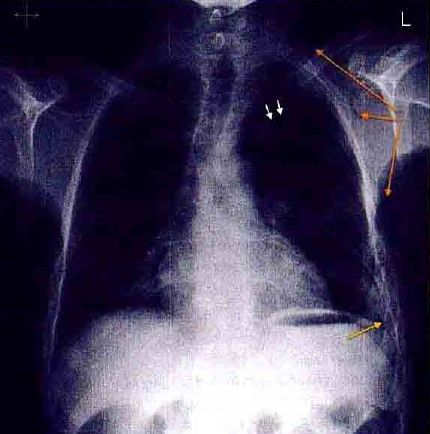
Caption under X-ray:
CXR shows a large left pneumothorax (pleural line indicated by white arrows) with shift of the trachea and mediastinum to the right. There is a subtle fracture of one of the lower left ribs (yellow arrow). Note also the extensive surgical emphysema extending into the neck (orange arrows).Is this X-ray adequate for diagnosis?
Yes
How will you manage this patient?
Urgent needle thoracostomy in the 4th or 5th intercostal space anterior to the mid axillary line, then chest tube insertion.
Now, patient is shocked, what are classes of haemorrhage?
Blood loss (ml)
Class I: <750 ml
Class II: 750–1500 ml
Class III: 1500–2000 ml
Class IV: >2000 mlBlood loss (%)
Class I: <15%
Class II: 15–30%
Class III: 30–40%
Class IV: >40%Pulse rate
Class I: <100
Class II: >100
Class III: >120
Class IV: >140Blood pressure
Class I: Normal
Class II: Normal
Class III: Decreased
Class IV: DecreasedRespiratory rate
Class I: 14–20
Class II: 20–30
Class III: 30–40
Class IV: >35Urine output
Class I: >30 ml/hr
Class II: 20–30 ml/hr
Class III: 5–15 ml/hr
Class IV: <5 ml/hrSymptoms
Class I: Normal
Class II: Anxious
Class III: Confused
Class IV: LethargicBase deficit
Class I: 0 to –2 mEq/L
Class II: –2 to –6 mEq/L
Class III: –6 to –10 mEq/L
Class IV: –10 mEq/L or lessNeed for blood products
Class I: Monitor
Class II: Possible
Class III: Yes
Class IV: Massive transfusion protocolIn which grade does the BP start dropping?
At grade 3
-
How will you manage the circulation of this patient?
Stop any obvious source of bleeding
Gain venous access by 2 large bore cannulas
Take blood for FBC, glucose, U&E, ABG, BG.
Cross match for 4 units of blood
Commence IV fluid resuscitation with 1-1.5 L of crystalloids
Consider blood transfusion if no response to fluids
Insert urinary catheter and start to monitor the patientHow will you monitor the response of the patient ? And what will you do if you noticed he is not improving?
Heart rate
Blood pressure
Capillary refill time
Urine output
Mental statusIf no improvement??
Transfer to HDU
Inform my consultant and HDU registrar
Insert central line.
Give blood according to Hb level
Give inotrope (mention it in the last because according to ATLS protocol no role of it)A CT was done for the patient and showed the following, what is your diagnosis ?
Liver tear
Grades of liver tear?
AAST (American Association for the Surgery of Trauma) liver injury scaleGrade I
hematoma: subcapsular, <10% surface area
laceration: capsular tear, <1 cm parenchymal depthGrade II
hematoma: subcapsular, 10-50% surface area
hematoma: intraparenchymal <10 cm diameter
laceration: capsular tear 1-3 cm parenchymal depth, <10 cm lengthGrade III
hematoma: subcapsular, >50% surface area of ruptured subcapsular or parenchymal hematoma
hematoma: intraparenchymal >10 cm or expanding
laceration: capsular tear >3 cm parenchymal depthGrade IV
laceration: parenchymal disruption involving 25-75% hepatic lobe or involves 1-3 Couinaud segmentsGrade V
laceration: parenchymal disruption involving >75% of hepatic lobe or involves >3 Couinaud segments (within one lobe)
vascular: juxtahepatic venous injuries (retrohepatic vena cava / central major hepatic veins)Grade VI
vascular: hepatic avulsion
Hello! It looks like you're interested in this conversation, but you don't have an account yet.
Getting fed up of having to scroll through the same posts each visit? When you register for an account, you'll always come back to exactly where you were before, and choose to be notified of new replies (either via email, or push notification). You'll also be able to save bookmarks and upvote posts to show your appreciation to other community members.
With your input, this post could be even better 💗
Register Login