MockCC10 AKI
-
Stem: Patient underwent major surgery (right hemicolectomy). The nurse noticed decrease in UOP.
Fluid chart given, what is diagnosis?
AKI
What is the DD for AKI?
Pre-renal
Dehydration
Sepsis
Renal
GN
Drugs
Post-renal
Ureteric stones
BPHPathophysiology of polyuric phase in AKI?
Because of inability of kidney to concentrate urine, due to recovery of the glomeruli first with no improvement in distal tubules which will lead to increase in GFR.
Why are uremic patients anaemic?
Uremic patients may develop a normocytic, normochromic anaemia for a number of reasons
Deficiency of erythropoietin (most important cause)
Bone marrow toxins
Bone marrow fibrosis
Increased red cell fragility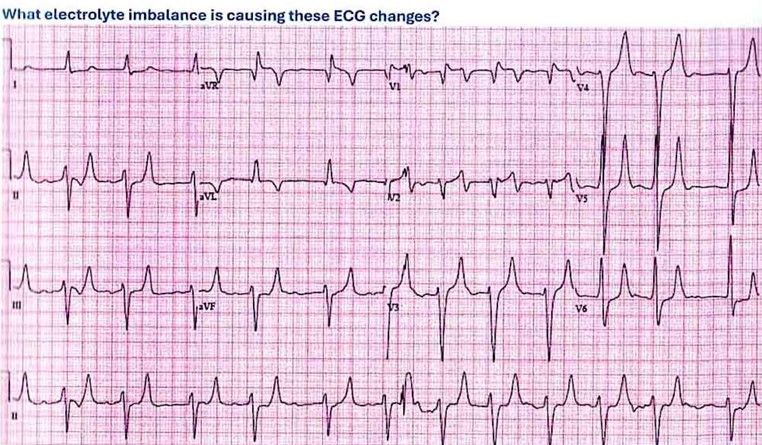
Hyperkalaemia
ECG findings in hyperkalaemia?
Flat P wave
Peaked T wave
Prolonged QRS
ArrhythmiasECG finding in hypokalaemia?
T wave inversion
Q-T interval Prolongation
S-T depression
U wave.Function of potassium?
Fluid balance
Nerve impulse function
Muscle function
Cardiac (heart muscle) function.Action of K⁺ on the cardiac muscle?
Excess K⁺ causes the heart to be dilated, flaccid and decreases the heart rate and can block the conduction of cardiac impulse.
i.e. increased K⁺ level will make action potential less negative decreasing the efficacy of cardiac muscle contractilityHomeostasis of potassium in body?
Gastrointestinal (diet)
Endocrine
-Aldosterone (promotes its excretion)
-Insulin (stimulates K⁺ uptake into cells)
Renal
-Acid base balance (K⁺ and H⁺ are exchanged at the cell membrane)
-Tubular fluid flow rateManifestations of hypokalaemia?
Muscular weakness and cramps
Arrhythmias
Paralytic ileus
ConfusionManifestations of hyperkalaemia?
Muscular weakness and cramps
Arrhythmias (can lead to cardiac arrest)
Diarrhoea
Abdominal pain
HypotensionManagement of hyperkalaemia?
Immediate managementImmediate ABCDE assessment.
Continuous cardiac monitoring » ECG
Stop all potassium-containing intravenous fluidsCorrection
Calcium gluconate (10 ml of 10%) is given IV
Give 5-10 U of insulin in 50 ml of 50% dextrose IV - Sodium bicarbonate (50 mmol IV over 5-10 min)
Haemodialysis
Salbutamol (5-10 g/min by intravenous infusion, or nebulized)
Calcium gluconateIf this patient is confused / has dementia, how will you consent for dialysis ?
The patient will be unable to give a consent, so I will proceed for dialysis for the patient best interest with two consultant signatures (consent type 4) after discussion with the family members.
Indication of dialysis?
Uremic encephalopathy
Severe acidosis pH < 7.2
Intractable hyperkalaemia > 6
Pulmonary oedema
Hello! It looks like you're interested in this conversation, but you don't have an account yet.
Getting fed up of having to scroll through the same posts each visit? When you register for an account, you'll always come back to exactly where you were before, and choose to be notified of new replies (either via email, or push notification). You'll also be able to save bookmarks and upvote posts to show your appreciation to other community members.
With your input, this post could be even better 💗
Register Login