Mock1CC Hyperthyroidism
-
Stem
A 38-year-old lady going for surgery. Pre-op bloods showed High T3, high T4, low TSH.Diagnosis?
Primary hyperthyroidism
What are the causes of hyperthyroidism?
Primary hyperthyroidism
Grave’s disease [most common cause]
Toxic multinodular goitre
Toxic solitary adenoma
Inflammation (thyroiditis), due to viral infections, some drugs
Iatrogenic [taking high dose of thyroid hormones]
Secondary Hyperthyroidism
TSH-secreting pituitary adenomaTalk about Thyroid hormone metabolism?
Deiodination
This is the most important step. Enzymes called deiodinases remove iodine atoms from T4 to convert it into T3 or inactive forms.
Conjugation
T3 and T4 can be conjugated with glucuronic acid or sulphate, making them water-soluble for excretion.
Excretion
Conjugated thyroid hormones are primarily excreted in the bile and faeces.What are the stages of thyroid hormone production?
Iodide ions enter the thyroid follicular cell by active pumping
Iodide is converted to iodine by TPO (Tyrosine peroxidase)
Iodine combines with tyrosine forming: monoiodotyrosine (MIT) and diiodotyrosine (DIT)
MIT + DIT = T3 (tri iodotyrosine)
DIT + DIT = T4 (tetra iodotyrosine)What are the functions of thyroxine (T4)?
Target tissue - Effect - Mechanism-Heart - Chronotropic and inotropic - Increased number of β‑adrenergic receptors; Enhanced responses to circulating catecholamines; Increased proportion of α‑myosin heavy chain (with higher ATPase activity)
-Adipose tissue - Catabolic - Stimulated lipolysis
-Muscle - Catabolic - Increased protein breakdown
-Bone - Developmental - Promote normal growth and skeletal development
-Nervous system - Developmental - Promote normal brain development
-Gut - Metabolic - Increased rate of carbohydrate absorption
-Lipoprotein - Metabolic - Formation of LDL receptors
-Other - Calorigenic - Stimulated oxygen consumption by metabolically active tissues (exceptions: testes, uterus, lymph nodes, spleen, anterior pituitary); Increased metabolic rateWhat are the possible complications if patient went to surgery without correction?
Thyroid storm (crisis)
High risk of MIWhat are the anaesthetic considerations?
Thyroid storm
MI
Delayed recovery from surgeryHow to prevent that?
Prepare patient preoperatively → Make the patient euthyroid by:
-Carbimazole or Lugol’s iodine
-Give beta blockersGiven ECG, what is the diagnosis?
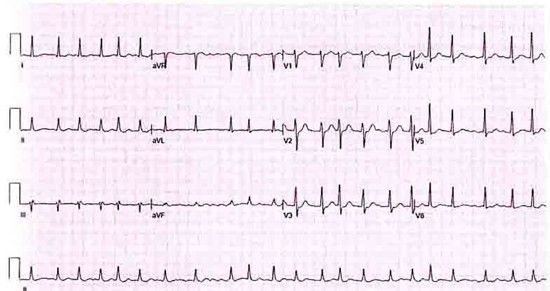
Atrial fibrillation
What is the clinical picture of thyroid crisis (storm)?
Fever
Tremor
Tachycardia, heart failure
Nausea and vomiting
Diarrhoea, dehydration
Restlessness, extreme agitation
Delirium or comaManagement?
This is a critically ill surgical patient so I will manage him according to CCrISP protocol with the ABCDE approach.
Then, specific management:
Carbimazole 10–20 mg every 6 hours
Beta blocker
Hydrocortisone
Cooling the patient (because of hyperthermia)
Lugol’s iodineWhat is Lugol’s iodine?
Also known as aqueous iodine and strong iodine solution. It is a solution of potassium iodide with iodine in water.
Where will you manage this patient?
In ITU
How does radioactive iodine act?
By destruction of follicles (permanent effect) so no thyroid hormone is released at all.
How does Lugol’s iodine act?
By decreasing the effect of TSH on the thyroid gland, leading to inhibition of iodine binding and reduced vascularity of the gland.
Role of beta blocker in treatment of AF
Blocks the effect of adrenaline on the heart → decreases heart rate.
Role of amiodarone in treatment of AF
Prevention and treatment of arrhythmia by slowing down the electrical signal in the heart.
Hello! It looks like you're interested in this conversation, but you don't have an account yet.
Getting fed up of having to scroll through the same posts each visit? When you register for an account, you'll always come back to exactly where you were before, and choose to be notified of new replies (either via email, or push notification). You'll also be able to save bookmarks and upvote posts to show your appreciation to other community members.
With your input, this post could be even better 💗
Register Login