China taxes condoms, contraceptive drugs in bid to spur birth rate
-
China removed a three-decade-old tax exemption on contraceptive drugs and devices from January 1 in new steps to spur a flagging birth rate.
Condoms and contraceptive pills now incur value-added tax of 13%, the standard rate for most consumer goods.
China exempted childcare subsidies from personal income tax and rolled out an annual childcare subsidy last year, following a series of "fertility-friendly" measures in 2024, such as urging colleges and universities to provide "love education" to portray marriage, love, fertility and family in a positive light.
Top leaders again pledged last month at the annual Central Economic Work Conference to promote "positive marriage and childbearing attitudes" to stabilise birth rates.
China's birth rates have been falling for decades as a result of the one-child policy China implemented from 1980 to 2015, and rapid urbanisation.
The high cost of childcare and education as well as job uncertainty and a slowing economy have also discouraged many young Chinese from getting married and starting a family.
-
China removed a three-decade-old tax exemption on contraceptive drugs and devices from January 1 in new steps to spur a flagging birth rate.
Condoms and contraceptive pills now incur value-added tax of 13%, the standard rate for most consumer goods.
China exempted childcare subsidies from personal income tax and rolled out an annual childcare subsidy last year, following a series of "fertility-friendly" measures in 2024, such as urging colleges and universities to provide "love education" to portray marriage, love, fertility and family in a positive light.
Top leaders again pledged last month at the annual Central Economic Work Conference to promote "positive marriage and childbearing attitudes" to stabilise birth rates.
China's birth rates have been falling for decades as a result of the one-child policy China implemented from 1980 to 2015, and rapid urbanisation.
The high cost of childcare and education as well as job uncertainty and a slowing economy have also discouraged many young Chinese from getting married and starting a family.
They need more slaves for the manufacturing meat grinder.
-
They need more slaves for the manufacturing meat grinder.
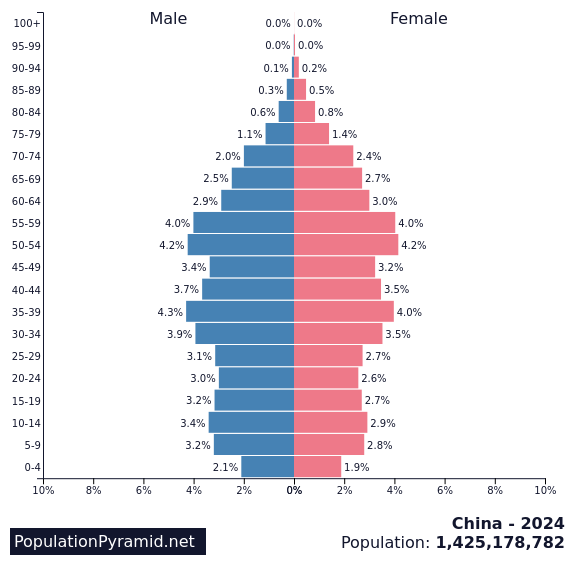
China has a pretty substantial demographics problem. Like, I'm not saying that this particular policy is the way to handle it or that it's effective, but it's very probably going to have a lot of unpleasant effects if they aren't able to turn it around. You'd expect them to be trying to do something about it.
Population Pyramids of the World from 1950 to 2100
Population Pyramids: China - 2024

PopulationPyramid.net (www.populationpyramid.net)
Their 50-54 age cohort is about 120 million.
Their 0-4 age cohort is about 50 million.
They currently have 1.4 billion people.
The UN projects them to have 633 million people in 2100.
If you want to have elderly people retiring and working-age people supporting them, then your ratio of retirees to working-age people going way up is going to create some pretty serious issues. Do you just have increasingly-decrepit people work until they go? Tax the working population a lot more? Slash the standard of living for the elderly? All of those are going to seriously suck for at least some portion of the public.
searches

What Is the Chinese Pension System and Why Are Its Problems Hard to Fix?
As the Chinese society ages, China not only loses its comparative advantage in labor but also faces a severe pension funding challenge. Chinese leaders have competing priorities but they do not have the resources to fund them all.

Council on Foreign Relations (www.cfr.org)
-
China has a pretty substantial demographics problem. Like, I'm not saying that this particular policy is the way to handle it or that it's effective, but it's very probably going to have a lot of unpleasant effects if they aren't able to turn it around. You'd expect them to be trying to do something about it.
Population Pyramids of the World from 1950 to 2100
Population Pyramids: China - 2024
PopulationPyramid.net (www.populationpyramid.net)
Their 50-54 age cohort is about 120 million.
Their 0-4 age cohort is about 50 million.
They currently have 1.4 billion people.
The UN projects them to have 633 million people in 2100.
If you want to have elderly people retiring and working-age people supporting them, then your ratio of retirees to working-age people going way up is going to create some pretty serious issues. Do you just have increasingly-decrepit people work until they go? Tax the working population a lot more? Slash the standard of living for the elderly? All of those are going to seriously suck for at least some portion of the public.
searches
What Is the Chinese Pension System and Why Are Its Problems Hard to Fix?
As the Chinese society ages, China not only loses its comparative advantage in labor but also faces a severe pension funding challenge. Chinese leaders have competing priorities but they do not have the resources to fund them all.
Council on Foreign Relations (www.cfr.org)
Tbh I think if any country is positioned to overcome demographics problems it's China. They have all of the manufacturing infrastructure and investing heavily into robotics and low maintenance systems. So I really dont understand such a stupid political move. As if 0.1$ more expensive condoms will start creating babies. It almost feels like a big show of control to people rather than anything tangible.
-
Tbh I think if any country is positioned to overcome demographics problems it's China. They have all of the manufacturing infrastructure and investing heavily into robotics and low maintenance systems. So I really dont understand such a stupid political move. As if 0.1$ more expensive condoms will start creating babies. It almost feels like a big show of control to people rather than anything tangible.
They have all of the manufacturing infrastructure and investing heavily into robotics and low maintenance systems. So I really dont understand such a stupid political move.
If you want to see what the future holds for a nation in that position, look no further than Japan. Its already facing the same demographic crisis, already trying to lean heavily into robots and automation. Japan also holds the same strong xenophobic stance to immigration, which would be the other way to address a falling birth rate. It's not looking good for Japan on this front. South Korea is not too far behind Japan. With the USA going to war with its immigrants, we'll be experiencing the same problem ourselves in another 20 to 40 years.
-
They have all of the manufacturing infrastructure and investing heavily into robotics and low maintenance systems. So I really dont understand such a stupid political move.
If you want to see what the future holds for a nation in that position, look no further than Japan. Its already facing the same demographic crisis, already trying to lean heavily into robots and automation. Japan also holds the same strong xenophobic stance to immigration, which would be the other way to address a falling birth rate. It's not looking good for Japan on this front. South Korea is not too far behind Japan. With the USA going to war with its immigrants, we'll be experiencing the same problem ourselves in another 20 to 40 years.
Tbh I think Japan is mostly doing fine and China has much more time given in entered the issue with tech that is much more mature.
-
Tbh I think Japan is mostly doing fine and China has much more time given in entered the issue with tech that is much more mature.
Lets say both countries are successful with automation. I think you're missing the bigger point of the working population collapse. Robots don't pay taxes.