Stomach, Pancreas, Duodenum
-
On diagram identify
Fundus
Body
Pylorus antrum
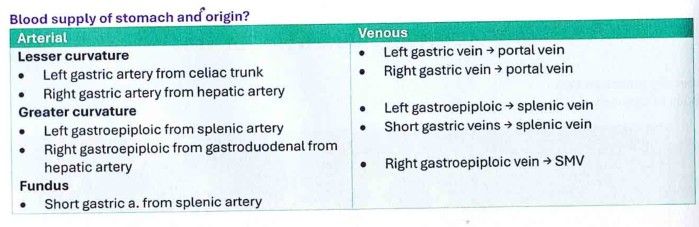
Pyloric canalBlood supply of stomach
On diagram identify
Head of Pancreas
Neck of Pancreas
TailBlood supply of pancreas?
ArterialSuperior pancreaticoduodenal artery (from gastroduodenal artery) supply head
Inferior pancreaticoduodenal artery (from SMA) supply head & uncinate process
Pancreatic branches (from splenic artery) supply tail & bodyVenous
Superior pancreaticoduodenal vein
Veins drain to splenic vein
Inferior pancreaticoduodenal veinCourse of splenic artery
Arise from celiac, pass above pancreas, behind stomach (separated from it by lesser sac), lienorenal ligament then ends by terminal branch in splenic hilum.
Describe ductal drainage system of pancreas?
Main pancreatic duct (of Wirsung): drains head, body and tail - opens into major duodenal papilla.
Accessory pancreatic duct (of Santorini): drains the uncinate process - opens into minor duodenal papilla.Vessel presents behind body of pancreas?
Splenic vein
Space between stomach and pancreas?
Lesser sac
Vessel present behind neck?
Portal vein
Peritoneal relations of the duodenum?
The first part of the duodenum lies within the peritoneum, but its other parts are retroperitoneal.
Vessels present in front and behind the third part of duodenum?
In front: Superior mesenteric artery & vein
Behind: IVCAortaRight gonadal veinHepatic artery runs in which part of peritoneum?
Lesser omentum
Clinical Correlation Tip
The fact that the portal vein forms behind the neck of the pancreas (by the union of the splenic and superior mesenteric veins) is a major "must-know" for surgical anatomy. If a tumor grows in the neck of the pancreas, it can quickly involve this major vein.Superior Mesenteric Artery (SMA) Syndrome is a rare but serious gastrointestinal condition. To understand it, you have to look at the specific "nutcracker" anatomy of the third part of the duodenum.
Normally, there is a cushion of mesenteric fat that keeps the angle between the Aorta and the SMA wide enough so the duodenum can pass through freely.
In SMA Syndrome, that mesenteric fat pad disappears or the angle narrows significantly. This causes the SMA to compress the duodenum against the aorta, creating a physical blockage.
The "Prone Relief" Sign: Patients often find that lying on their stomach (prone) or in the left lateral decubitus position relieves the pain, as gravity pulls the SMA forward, opening the trap.
Imaging: A CT scan or a "Barium Swallow" will show a dilated first and second part of the duodenum, with a sharp cutoff where the SMA crosses the third part.
Management:
Medical: The first goal is weight gain to restore the fat pad (often via a feeding tube placed past the obstruction).
Surgical: If medical management fails, a Duodenojejunostomy is performed, where a new path is created to bypass the compression.
Hello! It looks like you're interested in this conversation, but you don't have an account yet.
Getting fed up of having to scroll through the same posts each visit? When you register for an account, you'll always come back to exactly where you were before, and choose to be notified of new replies (either via email, or push notification). You'll also be able to save bookmarks and upvote posts to show your appreciation to other community members.
With your input, this post could be even better 💗
Register Login