Anatomy: Neck Triangles
-
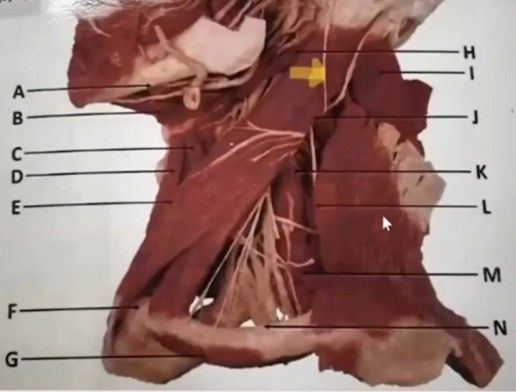
Q1: Identify structures from A to N?
A. Marginal mandibular nerve
B. Anterior belly of digastric
C. Superior belly of omohyoid
D. Sternohyoid
E. Sternocleidomastoid (anterior border)
F. Sternoclavicular joint
G. Pectoralis major
H. Posterior belly of digastric
I. Splenius capitis
J. Sternocleidomastoid (posterior border)
K. Scalene medius
L. Trapezius
M. Inferior belly of omohyoid
N. Brachial plexusQ2: What is the structure in yellow arrow?
Great auricular nerve
B: Nerve value?
Root value: (C2, C3)
C: Sensory distribution?
Skin of lower half of auricle
Skin over parotid gland
Angle of the mandible -
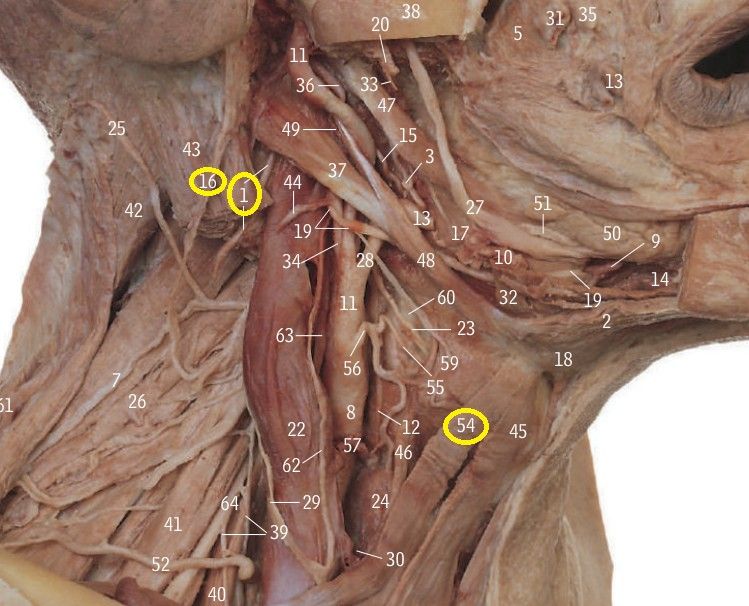
Q3. Identify structure No 16?
Great auricular nerve
Root value: (C2, C3)
Area of distribution: lower half of auricle, skin over parotid gland and angle of the mandibleQ4. Identify spinal accessory nerve?
Structure number 1
Q5. Identify muscles supplied by it?
Trapezius
SCM muscleQ6. How to test their function?
Trapezius:
Shrug the shoulder against resistance
Sternomastoid:
Turns the head to the contralateral side against resistanceQ7. If it's injured in the posterior triangle, which muscle will be affected?
Trapezius only
Q8. Identify omohyoid muscle?
54
Q9. What is the nerve supply?
Ansa cervicalis
Root value: C1, C2, C3 -
Q10. Identify submandibular gland
33
Q11. Name 3 nerves at risk on excision with function of one of them?
Lingual: general sensation of anterior 2/3 of tongue
Hypoglossal: all of the motor innervation of tongue except for the palatoglossus muscle
Marginal mandibular: ask patient to show his teethQ12. What is the muscle lying between the gland and the skin?
Platysma muscle
Nerve supply? How to test function?
Innervated by cervical branch of the facial nerve
Ask patient to tense his neckQ13. What is the muscle that divides the gland into superficial and deep parts?
Mylohyoid muscle
What is nerve supply?
Via the mylohyoid nerve
Which is a division of the inferior alveolar nerve, a branch of the mandibular division of the trigeminal nerveWhat is action?
Elevate the hyoid bone
Elevate the oral cavity
Depress the mandibleQ14. Type of secretion of submandibular gland?
Mixed serous and mucous
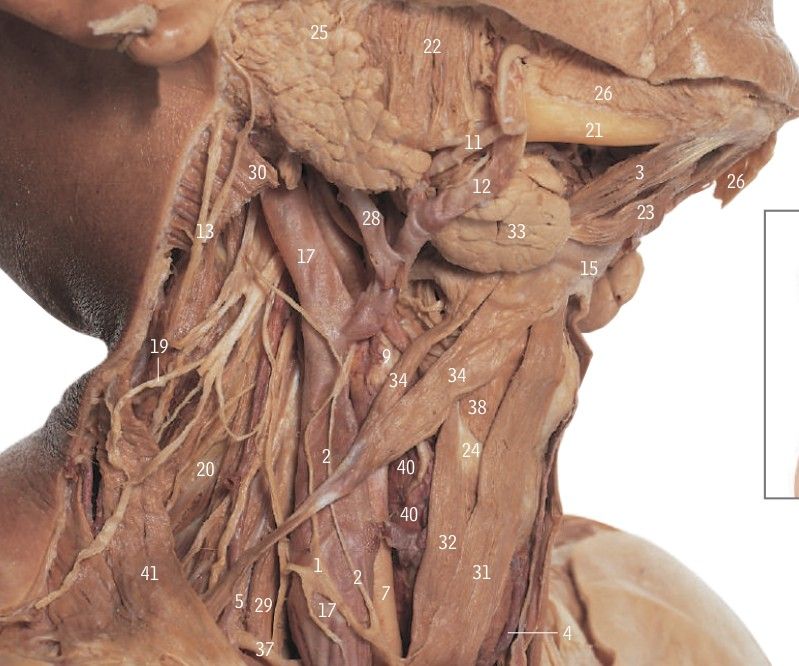
Q15. Identify Structure No. 9.
A: External Carotid Artery
What nerve passes just lateral to it and what’s its function?
Hypoglossal nerve
Function: Protrusion of tongue and side-to-side movement of tongue -
What is the most common part of the duct that is involved in a stone?
Middle 1/3
Why is this site most affected?
Due to looping of lingual nerve around duct, and thick mucus secretion and have to pour secretion in floor of mouth against gravity
What are digastric triangle boundaries and their nerve supply?
Superior: Inferior border of the mandible
Anterior: Anterior belly of the di gastric muscle
Posterior: Posterior belly of the digastric muscleNerve supply
The anterior belly of the digastric muscle is innervated by the mylohyoid nerve, which is a branch of the mandibular nerve
The posterior belly of the digastric muscle is innervated by the digastric branch of the facial nerve.Names & actions of extrinsic muscles of the tongue
Genioglossus: protrusion of the tongue & depression of the tongue tip
Hyoglossus: retraction of the tongue & depression of the lateral margins of the tongue
Styloglossus: retraction of the tongue & elevation of the sides of the tongue
Palatoglossus: Elevation of the posterior part of the tongueIf you have injury of Hypoglossal, lingual or marginal mandibular what will the patient have?
Marginal mandibularDrippling of saliva from corner of affected side
Poor speech articulation (slurred speech)
Asymmetry on smiling or cryingHypoglossal
Paralysis and atrophy in ipsilateral side
Deviation to ipsilateral side on protrusion
Poor speech articulationLingual
Loss of general sensation from ant 2/3 of tongue and floor of mouth
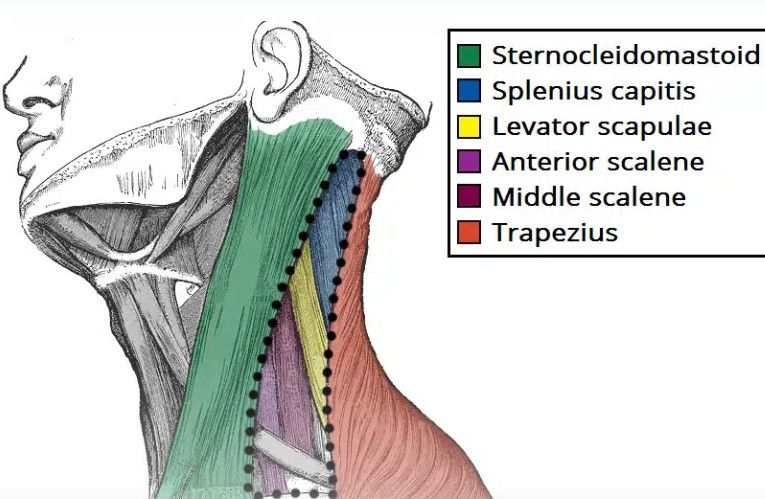
Loss of taste sensation from tongue onlyBoundaries of Posterior Triangle
Boundary Description
Apex Sternocleidomastoid and the Trapezius muscles at the Occipital bone
Anterior Posterior border of the Sternocleidomastoid
Posterior Anterior border of the Trapezius
Base Middle third of the clavicle
Origin & Insertion of Omohyoid
Origin - Insertion
Inferior belly
superior border of scapula near suprascapular notch - intermediate tendon
Superior belly
intermediate tendon - body of hyoid boneStudy Notes
Hypoglossal nerveBecause the genioglossus muscle on the healthy side "pushes" the tongue, it will deviate toward the side of the injury when the patient sticks it out.
Why lingual nerve injury causes loss of taste, even though it primarily carries general sensation?
While the Lingual nerve is a branch of the Mandibular nerve and carries general sensation (touch, pain, temperature), it also acts as a "highway" for taste fibers.The Chorda Tympani Connection. The reason a lingual nerve injury (specifically if it occurs after the two nerves join) causes loss of taste is due to the Chorda Tympani, a branch of the Facial nerve (CN VII). The Join: High up in the infratemporal fossa, the Chorda Tympani "hitches a ride" with the Lingual nerve. The Shared Path: From that point forward, they travel together as one physical cord.
Omohyoid, remember that its two bellies are held together by an intermediate tendon. This tendon is actually tethered to the clavicle by a deep layer of fascia. This is why when the muscle contracts, it doesn't just pull the hyoid down; it also helps maintain the patency of the internal jugular vein!
Hello! It looks like you're interested in this conversation, but you don't have an account yet.
Getting fed up of having to scroll through the same posts each visit? When you register for an account, you'll always come back to exactly where you were before, and choose to be notified of new replies (either via email, or push notification). You'll also be able to save bookmarks and upvote posts to show your appreciation to other community members.
With your input, this post could be even better 💗
Register Login