The Unreasonable Effectiveness of the Fourier Transform
-
This post did not contain any content.
-
This post did not contain any content.
So the reason pi is there is because everything gets decomposed into sinewaves?
-
So the reason pi is there is because everything gets decomposed into sinewaves?
Yeah, I think that's a good summary. I tried finding an article I read a while back that talked about it more from that angle, as in "Why does π keep showing up everywhere?", but can't track it down.
In consolation, here's the Tau Manifesto, which talks up why τ (i.e. 2π) is the better number to use, and also a post about the evil twin of π, called ϖ:
John Carlos Baez (@johncarlosbaez@mathstodon.xyz)
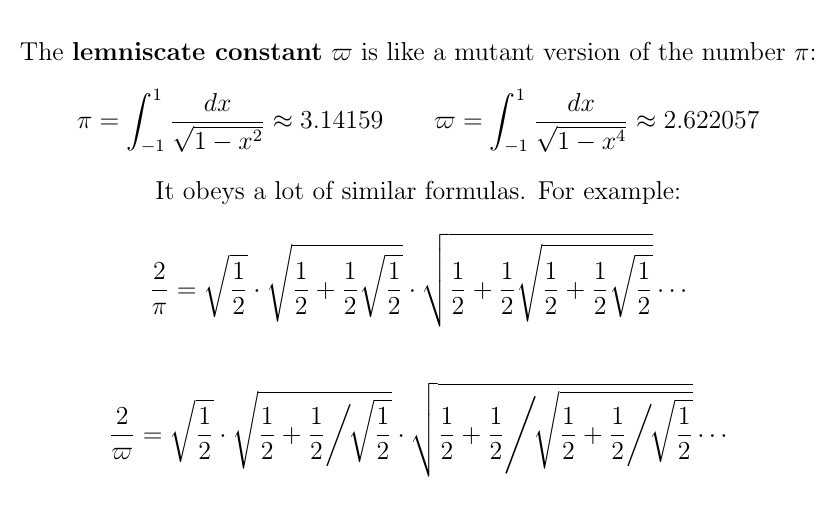
Attached: 1 image The number pi has an evil twin! It's a number called ϖ with many properties similar to π. There are even mutant trig functions connected to this number, called sl and cl. So maybe while you were studying trig in high school, some kid in another galaxy was having to memorize all the identities for these other functions. I doubt it. Just as pi and trig functions are connected to the circle, this number ϖ and its mutant trig functions are connected to a curve shaped like the symbol for infinity, ∞. But this curve is just less important than the circle. I'm not enough of a cultural relativist to believe there's a civilization that cares more about the shape ∞ than the shape ◯. This ∞-shaped curve is called a 'lemniscate', and ϖ is called the 'lemniscate constant'. I'll show you the lemniscate in my next post. A civilization will probably only get interested in ϖ when it gets interested in the lemniscate.... or the deeper math it's connected to. On our planet, it was Bernoulli, Euler and Gauss who discovered this math. (Why does unicode even have the symbol ϖ? Here's why: it's a script version of the Greek letter pi, sometimes called 'varpi' or 'pomega'.) (1/n)

Mathstodon (mathstodon.xyz)
-
Yeah, I think that's a good summary. I tried finding an article I read a while back that talked about it more from that angle, as in "Why does π keep showing up everywhere?", but can't track it down.
In consolation, here's the Tau Manifesto, which talks up why τ (i.e. 2π) is the better number to use, and also a post about the evil twin of π, called ϖ:
John Carlos Baez (@johncarlosbaez@mathstodon.xyz)
Attached: 1 image The number pi has an evil twin! It's a number called ϖ with many properties similar to π. There are even mutant trig functions connected to this number, called sl and cl. So maybe while you were studying trig in high school, some kid in another galaxy was having to memorize all the identities for these other functions. I doubt it. Just as pi and trig functions are connected to the circle, this number ϖ and its mutant trig functions are connected to a curve shaped like the symbol for infinity, ∞. But this curve is just less important than the circle. I'm not enough of a cultural relativist to believe there's a civilization that cares more about the shape ∞ than the shape ◯. This ∞-shaped curve is called a 'lemniscate', and ϖ is called the 'lemniscate constant'. I'll show you the lemniscate in my next post. A civilization will probably only get interested in ϖ when it gets interested in the lemniscate.... or the deeper math it's connected to. On our planet, it was Bernoulli, Euler and Gauss who discovered this math. (Why does unicode even have the symbol ϖ? Here's why: it's a script version of the Greek letter pi, sometimes called 'varpi' or 'pomega'.) (1/n)
Mathstodon (mathstodon.xyz)
Are you a EE by chance? Not many people dig into domain transformers for fun