The long shadow of the one-child policy: China pays for its biggest social experiment with a demographic crisis

-
cross-posted from: https://lemmy.sdf.org/post/48814505
The one-child policy was perhaps the greatest social experiment in human history. With the goal of curbing population growth at all costs, for just over 35 years China only allowed families to have one child. Communist leaders outlined the measures with a slogan in 1978: “One is better, two at most, leaving a three-year gap.” In 1980 it became state policy. By 1982, 96% of families in cities were having only one child, according to the Urban Household Survey.
Through a system of fines and penalties for non-compliance, the birth rate of what was then the world’s most-populous country was brought to a screeching halt. Until the policy itself became a problem. With the population pyramid inverting, Beijing put an end to the one-child policy in 2016, allowing couples to have two children to “balance demographic development and address the challenge of an aging population.” It hasn’t succeeded. Ten years later, the declining birth rate is one of the biggest headaches for the Chinese government.
The shadow cast is long. During its implementation, the one-child policy gave rise to horrific stories of abortions, abandonment, and children who grew up unregistered. It particularly targeted girls, whom many families rejected. At the same time, a new kind of only-child society was shaped, known as “little emperors” — hyper-developed, pampered children who have grown into adults while China’s GDP grew at an average rate of 10% and the country ascended to the pantheon of superpowers.
Ma Li, 53, raised her only daughter (now 24) hoping she would have “the same rights and opportunities as a boy.” “I raised her to be brave and know how to stand up for herself,” she says over the phone. After giving birth, she had an intrauterine device (IUD) inserted, as millions of women did during the years when birth control was widely available. She maintains that in her case it was a voluntary decision, although human rights organizations have documented that it was a widespread medical practice and, in many cases, subject to administrative pressure.
She acknowledges that, had she had the option, she would have wanted more children.
[...]
In China, the fertility rate continues its freefall, despite the fact that in 2021 married couples were allowed to have up to three children. According to the World Bank, only one child is born to every woman, one of the lowest replacement rates on the planet (for the population not to decline, 2.1 children must be born per woman). In 2022, the country’s population decreased for the first time since the 1960s. In 2023, it was surpassed by India as the most populous country. China is aging rapidly, and society is sustained by a shrinking number of working-age citizens. The birth rate and the number of newborns declined for seven consecutive years before experiencing a slight rebound in 2024. The United Nations projects that China’s population will shrink from its current 1.4 billion to 633 million by 2100, a change that could hinder growth.
[...]
Thus, these issues have become a “national security” priority. “The rise and fall of major powers are often profoundly affected by population conditions,” Chinese President Xi Jinping said in a 2023 speech. “Therefore, demographic security must be incorporated into the broader framework of national security and carefully planned.”
[...]
“The decline in the fertility rate is inevitable, like a giant boulder rolling downhill,” says Yi Fuxian, a researcher at the University of Wisconsin-Madison. It is a consequence of developed societies, and Asia is a prime example, with plummeting rates in Japan and South Korea. “China’s one-child policy accelerated the process,” adds the author of Big Country with an Empty Nest (2007). He believes that, despite the Chinese government’s efforts, it will be very difficult to roll that boulder back uphill.
Yi believes the one-child policy has changed attitudes toward motherhood and fatherhood and “distorted moral values about life,” he writes in an email. “Having only one child or no children at all has become the social norm.” He predicts that marriages will continue to decline (despite brief upticks in 2023 and 2025) and couples will postpone having children. He doesn’t think the policies introduced will achieve much. “What China is trying to do, Japan has already done.” And unsuccessfully. The country “is aging before it gets rich,” he concludes. And “doesn’t have the financial resources to fully follow Japan’s path.”
[...]
Statistics show that there are about 30 million more men than women in China, an anomaly stemming from the preference for sons during the one-child policy. But those like Jin herself haven’t had to compete with siblings for resources, particularly in education. Numerous studies prove that women have, on average, received more years of schooling than men, she writes. And this has contributed to giving their peers greater social and professional standing.
It has also given rise to a generation of more independent women, both economically and personally, and more self-assured. “Now there are more ‘sisters’ who are raising their voices and showing others that we have to fight for more rights and autonomy,” says Winnie Tang, 27, founder of Spring Reel, a series production company, in an exchange of messages. For her, women’s “liberation” means “having the right to refuse and not accept imposed demands.” In her mother’s time, “starting a family was the highest destiny a woman could aspire to.” Her generation, however, prioritizes other goals, such as developing “a career we are passionate about” or enjoying “the pleasure of doing the things we love.”
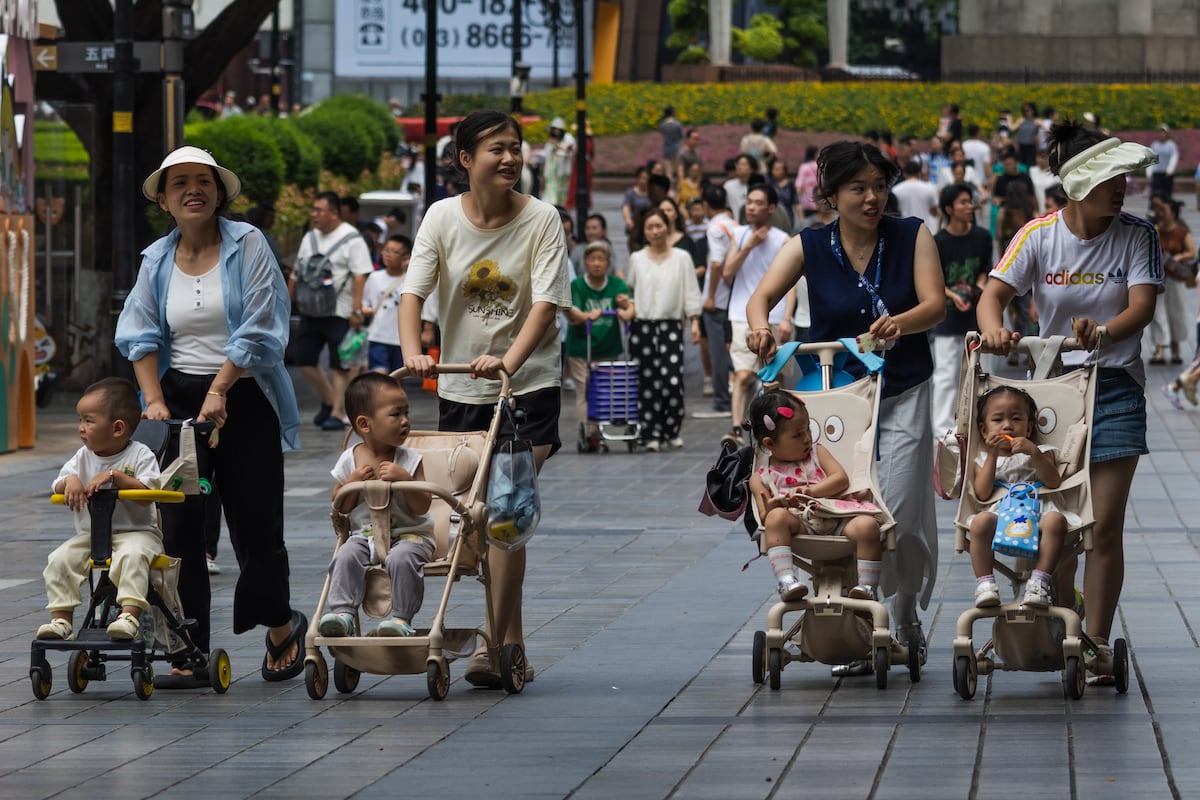
The long shadow of the one-child policy: China pays for its biggest social experiment with a demographic crisis
The low birth rate is one of the greatest headaches for Beijing, which in just 10 years has moved from strict family-planning rules to incentives for having children
EL PAÍS English (english.elpais.com)
-
cross-posted from: https://lemmy.sdf.org/post/48814505
The one-child policy was perhaps the greatest social experiment in human history. With the goal of curbing population growth at all costs, for just over 35 years China only allowed families to have one child. Communist leaders outlined the measures with a slogan in 1978: “One is better, two at most, leaving a three-year gap.” In 1980 it became state policy. By 1982, 96% of families in cities were having only one child, according to the Urban Household Survey.
Through a system of fines and penalties for non-compliance, the birth rate of what was then the world’s most-populous country was brought to a screeching halt. Until the policy itself became a problem. With the population pyramid inverting, Beijing put an end to the one-child policy in 2016, allowing couples to have two children to “balance demographic development and address the challenge of an aging population.” It hasn’t succeeded. Ten years later, the declining birth rate is one of the biggest headaches for the Chinese government.
The shadow cast is long. During its implementation, the one-child policy gave rise to horrific stories of abortions, abandonment, and children who grew up unregistered. It particularly targeted girls, whom many families rejected. At the same time, a new kind of only-child society was shaped, known as “little emperors” — hyper-developed, pampered children who have grown into adults while China’s GDP grew at an average rate of 10% and the country ascended to the pantheon of superpowers.
Ma Li, 53, raised her only daughter (now 24) hoping she would have “the same rights and opportunities as a boy.” “I raised her to be brave and know how to stand up for herself,” she says over the phone. After giving birth, she had an intrauterine device (IUD) inserted, as millions of women did during the years when birth control was widely available. She maintains that in her case it was a voluntary decision, although human rights organizations have documented that it was a widespread medical practice and, in many cases, subject to administrative pressure.
She acknowledges that, had she had the option, she would have wanted more children.
[...]
In China, the fertility rate continues its freefall, despite the fact that in 2021 married couples were allowed to have up to three children. According to the World Bank, only one child is born to every woman, one of the lowest replacement rates on the planet (for the population not to decline, 2.1 children must be born per woman). In 2022, the country’s population decreased for the first time since the 1960s. In 2023, it was surpassed by India as the most populous country. China is aging rapidly, and society is sustained by a shrinking number of working-age citizens. The birth rate and the number of newborns declined for seven consecutive years before experiencing a slight rebound in 2024. The United Nations projects that China’s population will shrink from its current 1.4 billion to 633 million by 2100, a change that could hinder growth.
[...]
Thus, these issues have become a “national security” priority. “The rise and fall of major powers are often profoundly affected by population conditions,” Chinese President Xi Jinping said in a 2023 speech. “Therefore, demographic security must be incorporated into the broader framework of national security and carefully planned.”
[...]
“The decline in the fertility rate is inevitable, like a giant boulder rolling downhill,” says Yi Fuxian, a researcher at the University of Wisconsin-Madison. It is a consequence of developed societies, and Asia is a prime example, with plummeting rates in Japan and South Korea. “China’s one-child policy accelerated the process,” adds the author of Big Country with an Empty Nest (2007). He believes that, despite the Chinese government’s efforts, it will be very difficult to roll that boulder back uphill.
Yi believes the one-child policy has changed attitudes toward motherhood and fatherhood and “distorted moral values about life,” he writes in an email. “Having only one child or no children at all has become the social norm.” He predicts that marriages will continue to decline (despite brief upticks in 2023 and 2025) and couples will postpone having children. He doesn’t think the policies introduced will achieve much. “What China is trying to do, Japan has already done.” And unsuccessfully. The country “is aging before it gets rich,” he concludes. And “doesn’t have the financial resources to fully follow Japan’s path.”
[...]
Statistics show that there are about 30 million more men than women in China, an anomaly stemming from the preference for sons during the one-child policy. But those like Jin herself haven’t had to compete with siblings for resources, particularly in education. Numerous studies prove that women have, on average, received more years of schooling than men, she writes. And this has contributed to giving their peers greater social and professional standing.
It has also given rise to a generation of more independent women, both economically and personally, and more self-assured. “Now there are more ‘sisters’ who are raising their voices and showing others that we have to fight for more rights and autonomy,” says Winnie Tang, 27, founder of Spring Reel, a series production company, in an exchange of messages. For her, women’s “liberation” means “having the right to refuse and not accept imposed demands.” In her mother’s time, “starting a family was the highest destiny a woman could aspire to.” Her generation, however, prioritizes other goals, such as developing “a career we are passionate about” or enjoying “the pleasure of doing the things we love.”
The long shadow of the one-child policy: China pays for its biggest social experiment with a demographic crisis
The low birth rate is one of the greatest headaches for Beijing, which in just 10 years has moved from strict family-planning rules to incentives for having children
EL PAÍS English (english.elpais.com)
Playing devil's advocate here, is this really a problem? It should be obvious that if you suddenly cut population growth you'd end up with this elderly vs young imbalance eventually as the generations that reproduced freely age out. This is part of the adjustment as things reach equilibrium. Now, granted, this 1 child policy will still create the same issue moving forward but in a less drastic scale. Ideally you'd have a 2 child policy to actually replace parents 1:1 with kids. But the point is, this imbalance was bound to happen regardless and you really won't see equilibrium until every person alive was born under the restricted policy. This is still too early to call it a failed experiment. It's right at the most crucial part.
-
Playing devil's advocate here, is this really a problem? It should be obvious that if you suddenly cut population growth you'd end up with this elderly vs young imbalance eventually as the generations that reproduced freely age out. This is part of the adjustment as things reach equilibrium. Now, granted, this 1 child policy will still create the same issue moving forward but in a less drastic scale. Ideally you'd have a 2 child policy to actually replace parents 1:1 with kids. But the point is, this imbalance was bound to happen regardless and you really won't see equilibrium until every person alive was born under the restricted policy. This is still too early to call it a failed experiment. It's right at the most crucial part.
It should be obvious that if you suddenly cut population growth you’d end up with this elderly vs young imbalance eventually as the generations that reproduced freely age out.
The problem is they did it too quickly. There's a huge number of aging people that won't be producing anything, but they will be consuming in their old age. The amount they consume will be far greater than the younger, smaller, population can produce. Additional, the young must produce goods and services for themselves to live their own lives.
This additional preasure on the younger generation is already also reducing birth rates accelorating this demographic crisis to a worse degree. The young aren't having kids in any significant numbers so there won't be enough to support the current young when they get old.
This is part of the adjustment as things reach equilibrium.
That is a massive understatement for what will be the hell that the aging population will encounter when they go unfed or uncared for when they need it the most and have no option to do for themselves.
Ideally you’d have a 2 child policy to actually replace parents 1:1 with kids. But the point is, this imbalance was bound to happen regardless and you really won’t see equilibrium until every person alive was born under the restricted policy.
2 child policy would still result in population decline. Equal replacement rate is 2.1. Some kids will die before having kids of their own. Others will grow to adulthood and choose not to have kids. So you'll need some sets of parents to have more than 2 kids themselves to make up for these shortfalls.
This is still too early to call it a failed experiment. It’s right at the most crucial part.
The "soft landing" point was a couple of decades ago probably back in the late 80s or mid 90s. Its going to be brutal in the future for China.
-
It should be obvious that if you suddenly cut population growth you’d end up with this elderly vs young imbalance eventually as the generations that reproduced freely age out.
The problem is they did it too quickly. There's a huge number of aging people that won't be producing anything, but they will be consuming in their old age. The amount they consume will be far greater than the younger, smaller, population can produce. Additional, the young must produce goods and services for themselves to live their own lives.
This additional preasure on the younger generation is already also reducing birth rates accelorating this demographic crisis to a worse degree. The young aren't having kids in any significant numbers so there won't be enough to support the current young when they get old.
This is part of the adjustment as things reach equilibrium.
That is a massive understatement for what will be the hell that the aging population will encounter when they go unfed or uncared for when they need it the most and have no option to do for themselves.
Ideally you’d have a 2 child policy to actually replace parents 1:1 with kids. But the point is, this imbalance was bound to happen regardless and you really won’t see equilibrium until every person alive was born under the restricted policy.
2 child policy would still result in population decline. Equal replacement rate is 2.1. Some kids will die before having kids of their own. Others will grow to adulthood and choose not to have kids. So you'll need some sets of parents to have more than 2 kids themselves to make up for these shortfalls.
This is still too early to call it a failed experiment. It’s right at the most crucial part.
The "soft landing" point was a couple of decades ago probably back in the late 80s or mid 90s. Its going to be brutal in the future for China.
I'm not saying this exact system worked. What I'm saying is pointing to the old vs young imbalance is disingenuous because ANY system that attempts to limit population growth will experience the same "sudden change". Hell, any system that limits ANYTHING will eventually have "group that had it" vs "group that didn't". Saying "there's a lot more old people from before we limited the population" is like telling me fire is hot.
The question shouldn't be "is the transition perfect" but "does the system that follows actually work?". We shouldn't discount all systems that want to limit population growth like this because ones with better metrics could actually work. And as we've seen, this program DID WORK. It lowered population. Just not in socially healthy ways.
It's just not logical to complain that if you have less of a growing population that your elderly population outnumbers them. That's LITERALLY THE PURPOSE OF POPULATION CONTROL. To have less being born. Of course the elderly from before will outnumber them - you weren't controlling their population!
-
I'm not saying this exact system worked. What I'm saying is pointing to the old vs young imbalance is disingenuous because ANY system that attempts to limit population growth will experience the same "sudden change". Hell, any system that limits ANYTHING will eventually have "group that had it" vs "group that didn't". Saying "there's a lot more old people from before we limited the population" is like telling me fire is hot.
The question shouldn't be "is the transition perfect" but "does the system that follows actually work?". We shouldn't discount all systems that want to limit population growth like this because ones with better metrics could actually work. And as we've seen, this program DID WORK. It lowered population. Just not in socially healthy ways.
It's just not logical to complain that if you have less of a growing population that your elderly population outnumbers them. That's LITERALLY THE PURPOSE OF POPULATION CONTROL. To have less being born. Of course the elderly from before will outnumber them - you weren't controlling their population!
What I’m saying is pointing to the old vs young imbalance is disingenuous because ANY system that attempts to limit population growth will experience the same “sudden change”.
You're treating this as a binary situation "growth" or "decline" but its not nearly that simple. The important factors are the amount of growth or decline and at the rate that is the problem with China's implementation.
We shouldn’t discount all systems that want to limit population growth like this because ones with better metrics could actually work.
No one is suggesting that.
And as we’ve seen, this program DID WORK. It lowered population. Just not in socially healthy ways.
...and...
It’s just not logical to complain that if you have less of a growing population that your elderly population outnumbers them. That’s LITERALLY THE PURPOSE OF POPULATION CONTROL.
That is empty logic, because it follows the letter of the goal* while entirely violating the spirit of it. Using that same logic we could fix global climate change just by murdering every human on the planet. See? It "DID WORK". Climate change fixed, but like China's situation, the cure is worse than the disease because in fixing climate change this way would mean there would be no humans around to benefit from the fix. But hey, it "DID WORK", right?
Of course the elderly from before will outnumber them - you weren’t controlling their population!
Again, binary thinking. A complete stable system is okay if the elderly outnumber the young by a small consistent percentage over time. That isn't what is happening in China. They are falling off a demographic cliff! Both match your statement of fewer young to elderly, but one is a sustainable controlled decline and the other is a crisis!
-
What I’m saying is pointing to the old vs young imbalance is disingenuous because ANY system that attempts to limit population growth will experience the same “sudden change”.
You're treating this as a binary situation "growth" or "decline" but its not nearly that simple. The important factors are the amount of growth or decline and at the rate that is the problem with China's implementation.
We shouldn’t discount all systems that want to limit population growth like this because ones with better metrics could actually work.
No one is suggesting that.
And as we’ve seen, this program DID WORK. It lowered population. Just not in socially healthy ways.
...and...
It’s just not logical to complain that if you have less of a growing population that your elderly population outnumbers them. That’s LITERALLY THE PURPOSE OF POPULATION CONTROL.
That is empty logic, because it follows the letter of the goal* while entirely violating the spirit of it. Using that same logic we could fix global climate change just by murdering every human on the planet. See? It "DID WORK". Climate change fixed, but like China's situation, the cure is worse than the disease because in fixing climate change this way would mean there would be no humans around to benefit from the fix. But hey, it "DID WORK", right?
Of course the elderly from before will outnumber them - you weren’t controlling their population!
Again, binary thinking. A complete stable system is okay if the elderly outnumber the young by a small consistent percentage over time. That isn't what is happening in China. They are falling off a demographic cliff! Both match your statement of fewer young to elderly, but one is a sustainable controlled decline and the other is a crisis!
So what happens if you let the elderly fall off that cliff? How will society look then? Oh, you don't have the answer? Is that because you don't have the data yet because the experiment hasn't concluded? What I've said all along?
Moron.
-
So what happens if you let the elderly fall off that cliff? How will society look then? Oh, you don't have the answer? Is that because you don't have the data yet because the experiment hasn't concluded? What I've said all along?
Moron.
So what happens if you let the elderly fall off that cliff? How will society look then?
The elderly will starve to death or die from neglect significantly shortening their lives. That's the physical effects. I can't imagine the psychological effect of middle aged adult sacrificing everything to try to keep their extended family alive and having to choose who gets to eat or get care. Alternatively, the government has to make these choices, but the result is the same. This most of an entire generation will die in poverty, or malnourished, or from neglect.
Do you just not understand how governments and societies work to feed and care for their elderly?
Moron.
Yep, we're done talking when you can't use adult words anymore and your resort to name calling. People that do what you're doing don't usually do it to one person. I looked at your post history and see you're toxic in many of your conversations frequently resorting to name calling when someone disagrees with you. This is especially true when someone is correcting your uninformed opinions. You do you, I suppose, but I won't see it anymore you'll be doing it on my blocklist. See ya!